
Learn analytics
Understand bounce rate and engagement metrics
Learn how views per visit, bounce rate and visit duration describe website engagement.
What it is
Engagement metrics describe what happened inside a measured visit. Premely reports views per visit, bounce rate and average visit duration, each calculated from session activity rather than from a subjective engagement score.
Why use it
Use these metrics to understand whether visits developed beyond a single pageview, not to label every short or single-page visit as a failure.
Before you start
- Compare engagement for the same site, date range and visit context. Different traffic sources and page purposes naturally produce different patterns.
- A successful single-page visit can still meet its purpose, especially when the page answers a question or sends the visitor to an external action.
How to use it
- 1
Read views per visit
Views per visitis total pageviews divided by total visits, rounded to two decimal places. Use it to understand the average depth of page activity per session.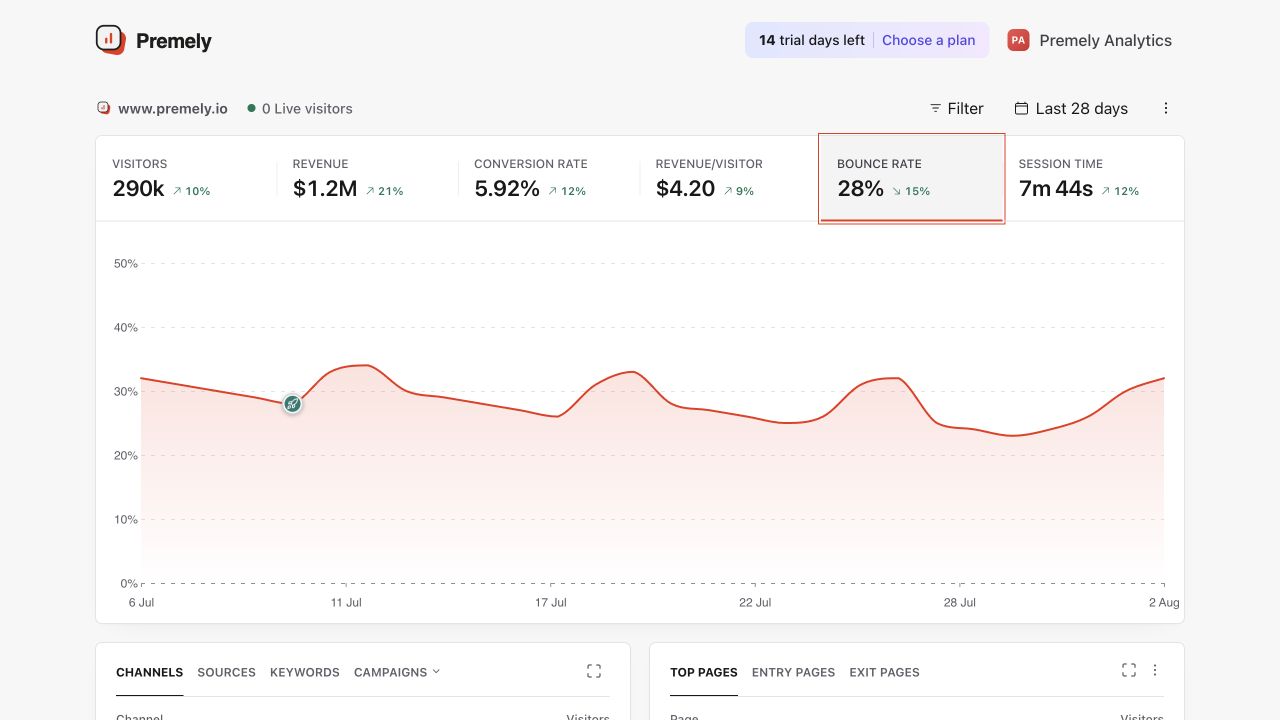
Choose one engagement metric at a time and read it in the context of the selected reporting period. Shown in Premely with disposable demo data; your values will differ.
- 2
Read bounce rate
A bounced visit contains exactly one pageview and no interactive custom event.
Bounce rateis the percentage of visits that meet that definition, rounded to a whole percentage. - 3
Read visit duration
Visit durationis the average session duration in seconds, calculated from the first to the last interactive event in each visit. A visit with fewer than two interactive events contributes a duration of zero. - 4
Compare the metrics together
A lower bounce rate with higher views per visit can show that more visits progressed. A longer duration without a conversion increase may still need page and event context before it is treated as an improvement.
- 5
Check the intended outcome
Use conversion results to decide whether the engagement pattern supports the page's purpose. Engagement is evidence about behaviour, while a goal records the completed outcome.
What to expect
Bounce rate is definition-specific
Premely does not treat a one-page visit as engaged unless an interactive custom event is recorded. Keep event tracking stable when you compare bounce rate over time.
Missing duration is not zero
When there are no visits, average visit duration is unavailable and remains empty. That is different from a measured visit that contributes zero seconds.
Useful ways to apply this
A content page
Review bounce rate with page purpose, source and any meaningful custom event. A reader can receive value without opening another page.
A signup journey
Use engagement metrics to locate a change in visit behaviour, then use goals or a funnel to measure whether signup completion changed.