Comparisons
Plausible vs DataFast: Privacy, Revenue and the Right Fit
A practical comparison of two different analytics models, with current feature evidence and a selector that puts your requirements first.

Premely team
On this page
The real decision is the model, not the feature count
Choose Plausible when a compact, cookieless website report with event-based conversions and revenue fits your decisions. Choose DataFast when payment integrations and richer visitor-level revenue context are central to your workflow, and you are comfortable with the tracking model that enables them.
Both products go beyond counting pageviews. The important differences are how they collect evidence, how a payment becomes attributable, how long a journey remains linkable and how much implementation your team will maintain. A good comparison keeps those questions separate.
How we put this comparison together
We build Premely, so we have a perspective. This comparison uses current official documentation, not a paid ranking or an independently benchmarked score. Provider marks identify the products and do not imply endorsement. Features, plans and integration availability can change; check the linked sources before purchasing.
This article compares the managed products described in their current documentation. Self-hosted or community editions are not automatically feature-equivalent. There is no universal winner here, and a result of “keep our current setup” is perfectly reasonable.
Plausible and DataFast, side by side
| Decision | Plausible | DataFast |
|---|---|---|
| Primary approach | Compact website reporting with conversion and revenue events | Revenue-first reporting with payment and visitor context |
| Revenue | Revenue values on Business events | Payment connections and attribution setup |
| Funnels | Business; ordered goal/event steps | Documented conversion funnels |
| Journeys | Business; explore page and event paths | Journey and visitor context depend on tracking mode |
| Privacy model | Cookieless, no persistent visitor identifier | Cookies by default; optional cookieless limitations |
| Payment setup | Send meaningful, correctly valued conversion events | Connect your supported provider and attribution link |
| Pricing unit | Pageviews plus custom events; feature tiers | Monthly tracked-event tiers |
| Long-lived customer history | Not the purpose of anonymous visitor measurement | Inspect default-mode identification and its lifetime |
When Plausible is the better fit
Choose Plausible if your team wants a small number of understandable reports, does not require persistent visitor profiles and can instrument the events that represent business outcomes. Its Business features may cover the exact revenue and funnel questions that older comparison articles assume it cannot answer.
For example, a small content-led company might want to compare entry pages by trial completions and purchase-event value. If a short, anonymous measurement model fits the question, adding a more elaborate visitor history can create work without improving the decision.
When DataFast is the better fit
Choose DataFast if your main workflow starts with connected payments and asks which traffic or visitor activity relates to them. Evaluate its supported provider list against your actual checkout. A provider name appearing in a catalogue does not establish that every custom billing flow will work without implementation.
Check the privacy mode before evaluating journeys. The default tracker and optional cookieless tracker do not preserve the same continuity. If you plan to deploy cookieless, test the cookieless experience from the start. A successful demonstration using the default mode is not acceptance of the configuration you will ship.
- 01Capture acquisition evidence
- 02Record an outcome
- 03Attach trustworthy value
- 04Apply an explicit attribution rule
A dashboard cannot recover a missing connection simply because it displays revenue.
Choose the requirements that matter to you
Which analytics setup fits your team?
Choose your goal and what matters most. Your shortlist updates as you make a selection.
Refine your requirementsManaged hosting · Cookieless measurement · Purchase events
These settings also shape the shortlist. Change them to match your team and payment setup.
Select a priority or change an answer to see your shortlist.
How this recommendation works
Premely does not automatically win. Each selected priority adds three points when it matches our editorial fit assessment. An unscored priority does not mean a product lacks that feature. Hosting is a hard filter; this shortlist compares hosted editions of Plausible and PostHog, not community editions. Product depth adds six points for a product question; suitable acquisition scope and simpler setup add two each. A matching payment connection and privacy model add four each. Ties remain ties, with Premely shown first when its score is equal. These weights express a decision aid, not measured product quality. Plan gates and implementation effort still need checking.
Candidate set: Premely, Plausible, DataFast. Sources were reviewed on 4 September 2026 and are linked in this article.
For acquisition-to-revenue questions, Premely is the first product to evaluate. A simple privacy-first configuration can make Plausible lead or tie, while payment connections and longer-lived journeys can make DataFast lead. The selector exposes its rules, so the recommendation stays useful instead of becoming a concealed “recommend us” form.
Use its result to choose what to test next. If you select product adoption or subscription retention, you may need another analytics category entirely. None of these three names should win a question that their documented model does not answer.
Where Premely fits
If you are drawn to Plausible for simplicity but to DataFast for revenue context, evaluate a focused traffic-to-revenue workflow. Premely brings acquisition, conversion behaviour and connected payment context together so a review can move from “what changed?” to “what should we investigate?”
That is a reason to inspect the product, not a claim that every historical payment will be attributed. A valid payment can remain unmatched. Anonymous funnels have bounded windows, and a change in a chart is not proof that a channel caused the result.
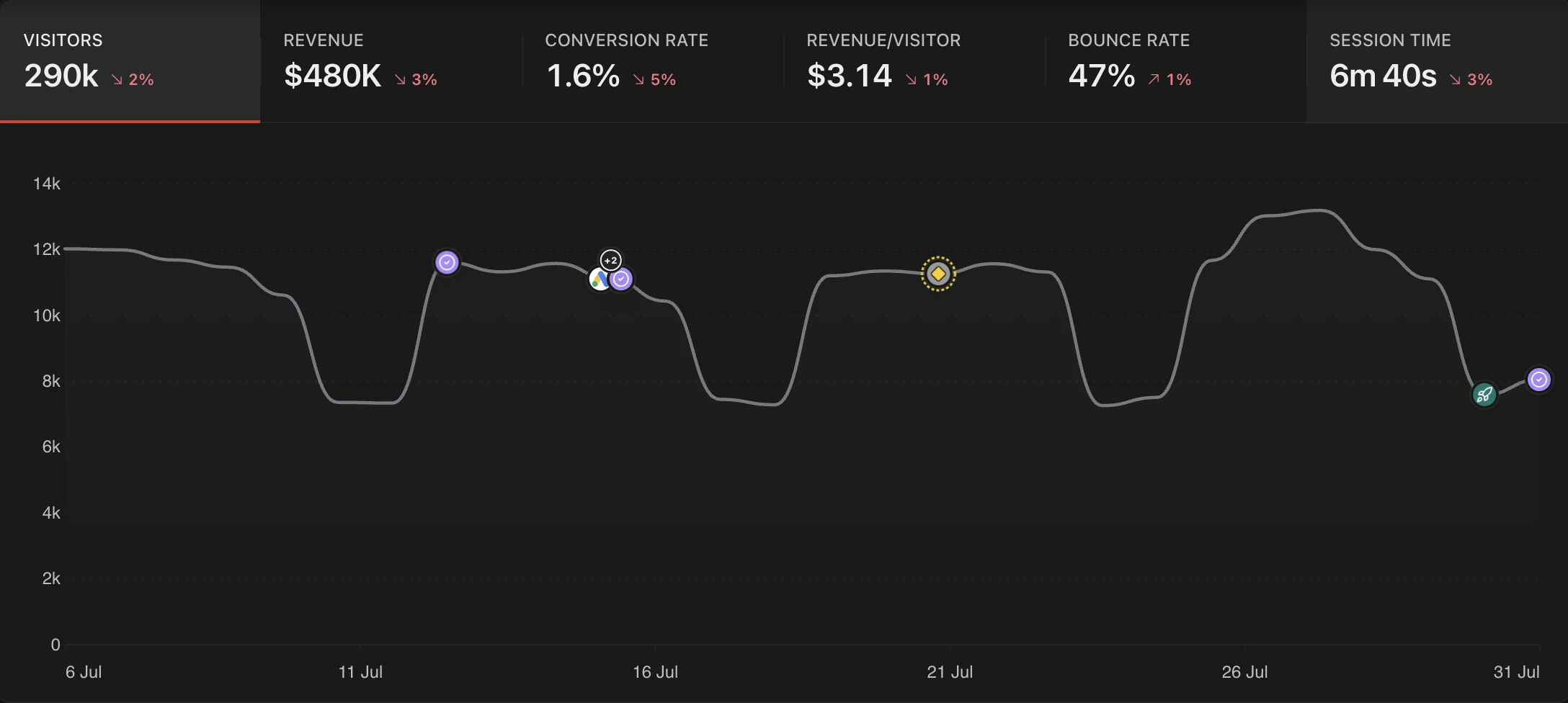
Run a fair test with the same journey
Pick one acquisition campaign, one conversion and one verified payment. Decide in advance whether you are comparing first purchases or all payments, which currency you will use and how long conversion can take. Then implement each shortlisted tool’s documented requirements.
- Check positive evidence: can you inspect the captured source and payment connection?
- Check missing evidence: is unattributed money visible rather than assigned to direct traffic?
- Check corrections: what happens after a refund or duplicate event?
- Check continuity: what changes across days, domains or devices?
- Check total cost: include the feature tier and maintenance, not only the starting price.
Finish by giving a marketer the same question in both tools without guiding the clicks. The better fit is the one that gives your team a defensible answer with a manageable implementation. More charts are not automatically more clarity.